Zion Road’s 373 Long-Stay Apartments Are Not Part of the Condo Supply
Construction is underway, but buyers should separate the 706 saleable homes from the operator-held rental component—and read the wider pilot carefully.
Published 2026-10-08 · 6 min read
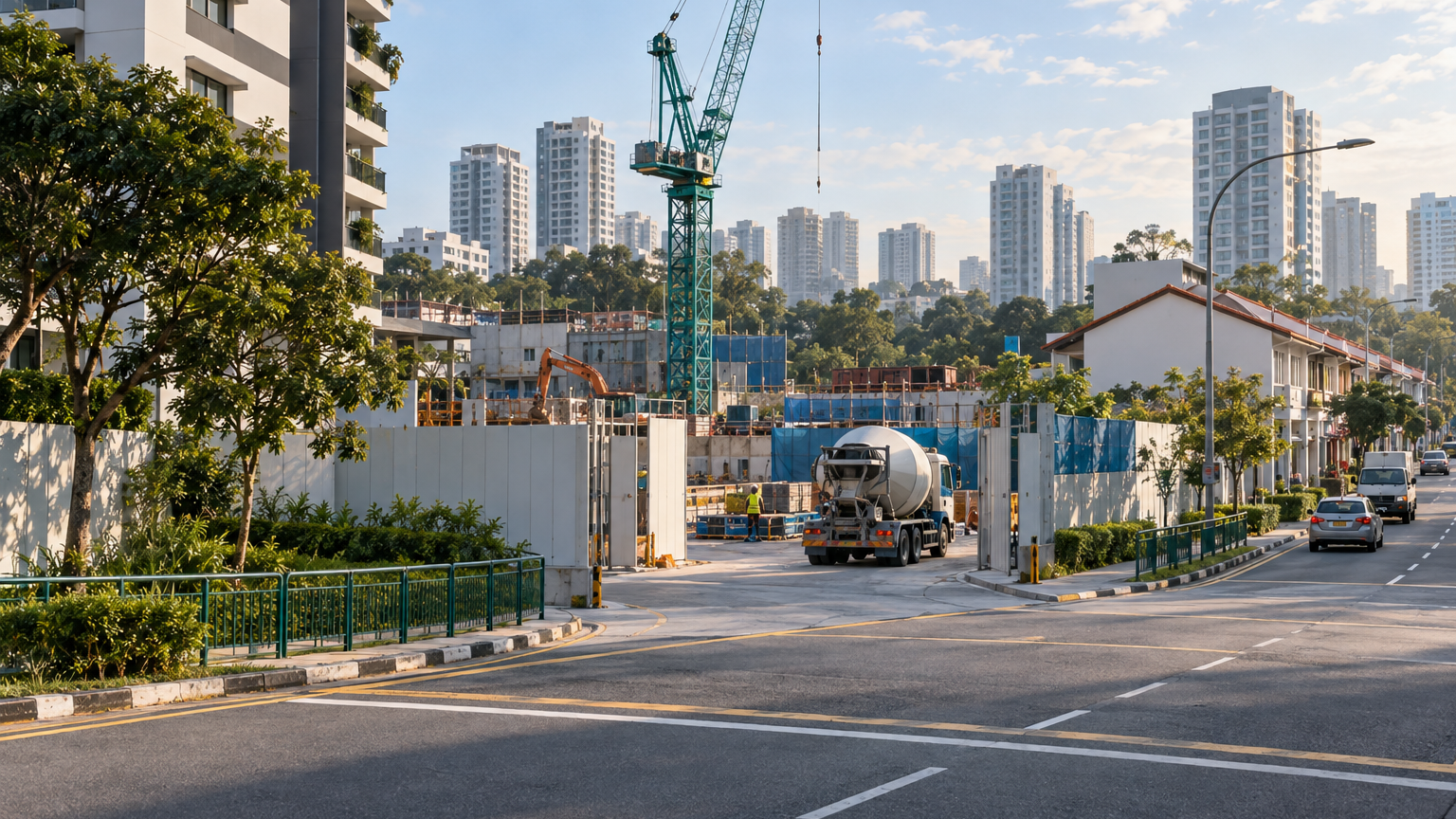
Construction has started on Singapore’s first Serviced Apartments II (SA2) project at Zion Road. The mixed-use development announced by City Developments Limited (CDL) and Mitsui Fudosan comprises 706 condominium homes for sale, 373 long-stay serviced apartments and commercial space.
That split matters to anyone comparing the condominium with a resale home. The 373 serviced apartments are not additional condo units buyers can select: they must remain under one owner and are intended for stays of at least three months.
Two kinds of housing, but only one is for sale
The Urban Redevelopment Authority (URA) introduced SA2 in December 2023 as a form of serviced accommodation for stays of three months or longer. Unlike a strata-titled condominium, an SA2 development cannot be divided into units that are individually owned and sold. It is expected to be held and operated as one asset.
At Zion Road, this creates two distinct pools of housing on the same mixed-use site. Condo buyers choose from the announced 706 saleable homes; the 373 SA2 apartments belong to a separate rental operation.
Together, those figures make 1,079 announced dwellings. SA2 accounts for about 35% of that total by unit count, based on a straightforward calculation—but it accounts for none of the units available for individual purchase.
The distinction was built into the land tender. URA awarded the 99-year site in April 2024 for S$1.106888 billion, with at least 20,000 sq m of its maximum 85,557 sq m gross floor area reserved for SA2 use. Gross floor area is the total permitted floor space, not the physical land area.
For a buyer, the useful supply number is therefore 706, not 1,079. The next questions concern the condo’s confirmed unit mix, layouts, stack positions and circulation through a site that will also contain rental and commercial components.
The other pilot sites followed different paths
Zion Road is only one part of the SA2 experiment. The tender history at Upper Thomson Road and Media Circle shows why it is too simple to conclude that one location succeeded while the others failed.
Upper Thomson Road Parcel A initially carried a compulsory SA2 component. When that tender closed in June 2024, URA received no bids.
URA subsequently said it would return the site to the Government Land Sales programme without mandatory SA2 use, following market feedback. SA2 could still be considered there, subject to approval, but developers would no longer have to include it.
That revised site attracted five bids and was awarded in October 2025 to Wee Hur Property and GSC Holdings for S$613.939 million. URA estimated capacity for about 595 homes, although the eventual number remains a matter for the developer and approval process.
The five-bid result cannot be read as developer support for compulsory SA2 because the obligation had already been removed. What changed was not merely the tender date: bidders were evaluating a materially different development proposition.
Media Circle produced another outcome. URA received one S$120.089 million bid for its dedicated 60-year SA2 parcel but declined to award the site because it considered the price too low.
The parcel remains on URA’s Reserve List, meaning it is available for a developer to apply for its release rather than being an awarded or approved project.
What the tender results actually show
Zion Road combines a conventional for-sale condominium with a long-term rental operation on a 99-year site. That gives its developers a different business structure from a dedicated SA2 parcel such as Media Circle.
The tender sequence suggests that developer interest depended on the complete package: tenure, location, compulsory uses, the amount of saleable housing and the flexibility available. Upper Thomson’s later result is particularly revealing because bids appeared only after URA removed the mandatory SA2 condition. That is an interpretation of the tender changes and outcomes, not a disclosed account of each bidder’s financial calculations.
A land bid also contains no direct evidence of future rents for the SA2 apartments or nearby private homes. It does not disclose achieved rents, occupancy, running costs or the eventual tenant profile. Treating the Zion Road award as a rental-yield forecast would mix up land-development economics with the performance of a finished rental property.
Timing deserves the same care. Mitsui Fudosan said construction began in August 2025 and described 2030 as the tentative opening year for the SA2 component. That is an announced plan, not confirmation that the rental apartments are already operating or a guarantee that every element will arrive unchanged.
How to compare the condo with a resale home
The SA2 component may shape everyday life at the completed development, but the practical effect will depend on the final design and operating arrangements. Buyers should look for clear information about entrances, lift access, drop-off points and how the condo, rental accommodation and commercial areas connect.
Unit selection still begins inside the home. Layout efficiency, storage, bedroom dimensions, outlook, traffic exposure and distance from busy shared areas are more useful decision points than a broad assumption that the serviced apartments must either help or hurt condo values.
A completed resale home offers evidence that a new launch cannot yet provide. Buyers can visit at different times, hear actual road noise, inspect the outlook and observe how residents use the estate. A new home offers a fresh lease and fittings, but buyers rely more heavily on plans, specifications and an expected delivery timetable.
Supply should also be kept in the correct columns. Zion Road adds 706 announced homes for individual sale and 373 operator-held rental apartments. The latter expand long-stay rental accommodation, but they do not create 373 more condos competing for buyers or appearing later as individually owned resale units.
The practical comparison is therefore between a specific Zion Road condo unit and the completed homes available elsewhere—not between 1,079 supposedly interchangeable units. Start with the home you can actually buy, then examine its position within the mixed-use site and how much uncertainty you are willing to accept before completion.