Thomson View sold S$108m below its guide price—but buyers cannot bank the saving
The Bright Hill Drive deal fixes the land cost at S$810 million. Its future homes, layouts, launch date and prices remain unannounced.
Published 2026-10-08 · 6 min read
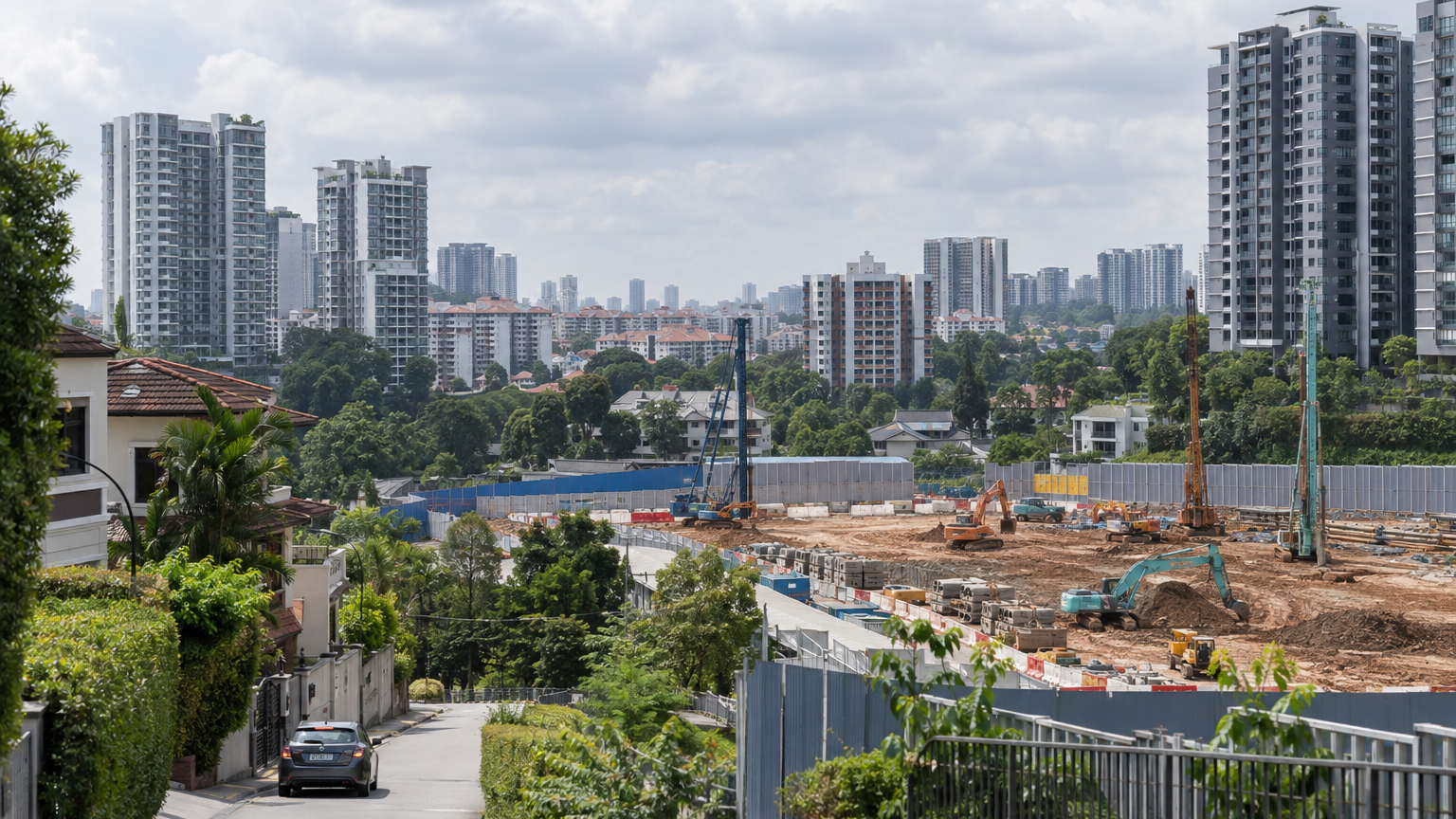
The former Thomson View condominium was marketed for collective sale at S$918 million in 2024. The eventual consortium paid S$810 million and completed the purchase on 2 October 2025—a difference of S$108 million.
That is meaningful for anyone watching the Bright Hill Drive site: the developer’s starting land bill is lower than the earlier guide suggested. But it is not an 11.8% discount waiting to be passed to buyers. No official project name, launch price, unit mix or sales date has been announced in the primary disclosures reviewed.
What the S$108 million gap actually represents
The arithmetic is straightforward. Subtract the S$810 million completed acquisition from the S$918 million guide price, and the difference is S$108 million. Divide that difference by S$918 million, and it works out to about 11.8%.
The important distinction is between a guide and a sale price. The guide was the amount attached to the collective-sale offering—not the price of an earlier completed transaction. The S$810 million consideration is what the purchasers agreed to pay.
This was also not an instant, unconditional deal. UOL announced the acquisition agreement in October 2024. The High Court issued the collective-sale order on 1 July 2025, and Singapore Land Group confirmed legal completion on 2 October 2025.
The purchasing structure has several layers. United Venture Development (No. 8), owned 80:20 by subsidiaries of UOL Group and Singapore Land Group, joined CapitaLand Development’s CL Onyx in the acquisition. The two purchasing sides are participating on a 50:50 basis.
For a future home buyer, the practical conclusion is modest but useful: the final land input is lower than a calculation based on the old guide price would suggest. Any forecast still using S$918 million as though that were the achieved sale price starts from the wrong number.
Why cheaper land does not mean homes 11.8% cheaper
Land is only one part of a new condominium’s cost. The developers must also account for construction, consultants, financing, approvals, marketing, common facilities and the time taken to complete and sell the project. The eventual design matters too: different unit sizes, layouts and building configurations distribute costs differently.
Pricing is not simply “total cost plus the same profit on every unit”. Developers can release homes in phases, vary prices by stack and floor, and charge differently for attributes such as orientation, outlook and private outdoor space. The market at the time of sale—and the other new and resale homes buyers can choose—will also shape the asking prices.
That makes the 11.8% figure a poor shortcut for forecasting a future price per square foot. It compares an opening guide with a negotiated acquisition, rather than two alternative cost plans for the same approved development.
There is another unknown: the replacement project itself. The verified site covers 540,314 sq ft, is zoned residential and has a gross plot ratio of 2.1. Its existing 99-year lease began on 7 April 1975. These details describe the acquired land; they do not establish the number or sizes of the future homes.
Earlier collective-sale marketing discussed a feasibility concept involving 1,240 homes. Buyers should not treat that as the final development programme: the developers’ subsequent primary announcements cited here do not confirm that number, a unit mix or an approved redevelopment scheme.
There is not enough information to choose a unit yet
Online marketing sites may already use a project name and publish apparent launch details. The primary company disclosures reviewed for this article identify the transaction as the acquisition of Thomson View Condominium at 1–17E Bright Hill Drive; they do not announce “Thomson Reserve” as the official replacement-project name.
They also do not provide floor plans, stack positions, facilities, parking provision, completion dates or indicative home prices. Without those details, a serious unit comparison is premature.
When official plans arrive, the land-price story should sit behind more immediate liveability questions:
- How efficient is each layout after accounting for corridors, balconies and structural columns?
- Which stacks face roads, communal facilities, neighbouring blocks or afternoon sun?
- How far are the blocks from the site entrance and everyday transport routes?
- Is the price premium for a higher floor or preferred orientation proportionate?
- What are the estimated maintenance fees for the unit type?
These details determine how a home works from Monday to Sunday. A seemingly attractive price per square foot can conceal wasted internal space, while a dearer unit may offer a layout that lets a household avoid moving again too soon.
The broad location is easier to establish. The developers describe the roughly five-hectare site as being near Upper Thomson MRT station, Thomson Plaza, Ai Tong School and surrounding parks and nature reserves. Exact walking routes, entrance positions and claimed school advantages should still be checked against the eventual approved plan and the rules applying to the individual household.
New launch versus resale: wait for like-for-like evidence
The acquisition could eventually add a substantial new private-housing choice to the Upper Thomson area, but “new” is not automatically better value. A new launch may offer a fresh lease, newer fittings and progressive payments during construction. Buyers must accept waiting time, construction and completion risk, and the difficulty of judging a home that cannot yet be physically inspected.
A completed resale condominium offers the opposite kind of evidence. Buyers can inspect the actual light, traffic noise, lift access and common areas. They can also see recent completed transactions rather than relying only on a developer’s price list. The trade-off may include an older lease, renovation spending and ageing facilities.
A fair comparison therefore needs matched homes—not simply a future launch average against a neighbourhood resale average. Compare units with similar bedroom counts, usable internal space, floor height, orientation, tenure and access to transport. Then add renovation, maintenance fees and the cost of waiting before deciding which headline price is genuinely lower for the household.
The next useful number is the unit price, not another land estimate
The completed S$810 million deal gives buyers a firm base fact. It replaces the old guide price in any discussion of what the consortium actually paid, and the S$108 million gap may give the developers more room than the earlier guide implied.
It does not settle how that room will be used. The consortium could change the product, absorb higher development costs, price against competing projects or vary margins across different releases. Until official plans and prices arrive, converting the land transaction into a supposedly precise launch price would create confidence without evidence.
The sensible next step is to save the site, not a speculative price forecast. When formal sales material is released, compare the actual unit plans, facing, usable space and total price with completed alternatives nearby. That is when the S$810 million acquisition becomes one useful input in a real buying decision—not a promised discount.