Family walks away from $30,000 after new-launch unit fails the space test
The family chose a Kerrisdale resale three-bedder instead, after finding their Ang Mo Kio booking too small for five and too late for their needs.
Published 2026-11-20 · 5 min read
A family of five gave up $30,000 on a new-launch condo purchase in Ang Mo Kio after deciding the unit was too small and would not be ready when they needed it. According to their reported account, they changed course and bought a resale three-bedroom unit at Kerrisdale for between $1.8 million and $2.2 million.
The November 2026 account puts a concrete cost on a mismatch discovered after booking: the family wanted more room, but their chosen launch could not meet either their space needs or their timing. Their eventual choice turned on everyday requirements—beds that fitted, room for study tables and a renovation budget they could manage.
They had sold, but their next home did not fit
The couple had taken an option to purchase, or OTP, for the Ang Mo Kio unit days after selling their previous condo home in Whampoa. They wanted a larger home for their growing household, while also hoping to buy a property that would appreciate over time.
After paying the booking fee, they reconsidered. The account describes two problems: insufficient space for five people and a project that would not be ready in time. They contacted advisers Cherie Chua and Grady Chew in July 2026 to restart their search for a resale home.
Those are separate requirements. A more generous layout would not, by itself, solve a move-in deadline. Equally, an earlier handover would not make an unsuitable bedroom arrangement work. For a buyer comparing launches, the useful lesson is to settle both questions before treating a unit as a viable replacement home.
The reported sequence also matters: the family had already sold before securing a suitable next home. Their search was therefore not just about choosing an appealing project; it was about finding somewhere that could accommodate the household when required.
What “three bedrooms” meant for this family
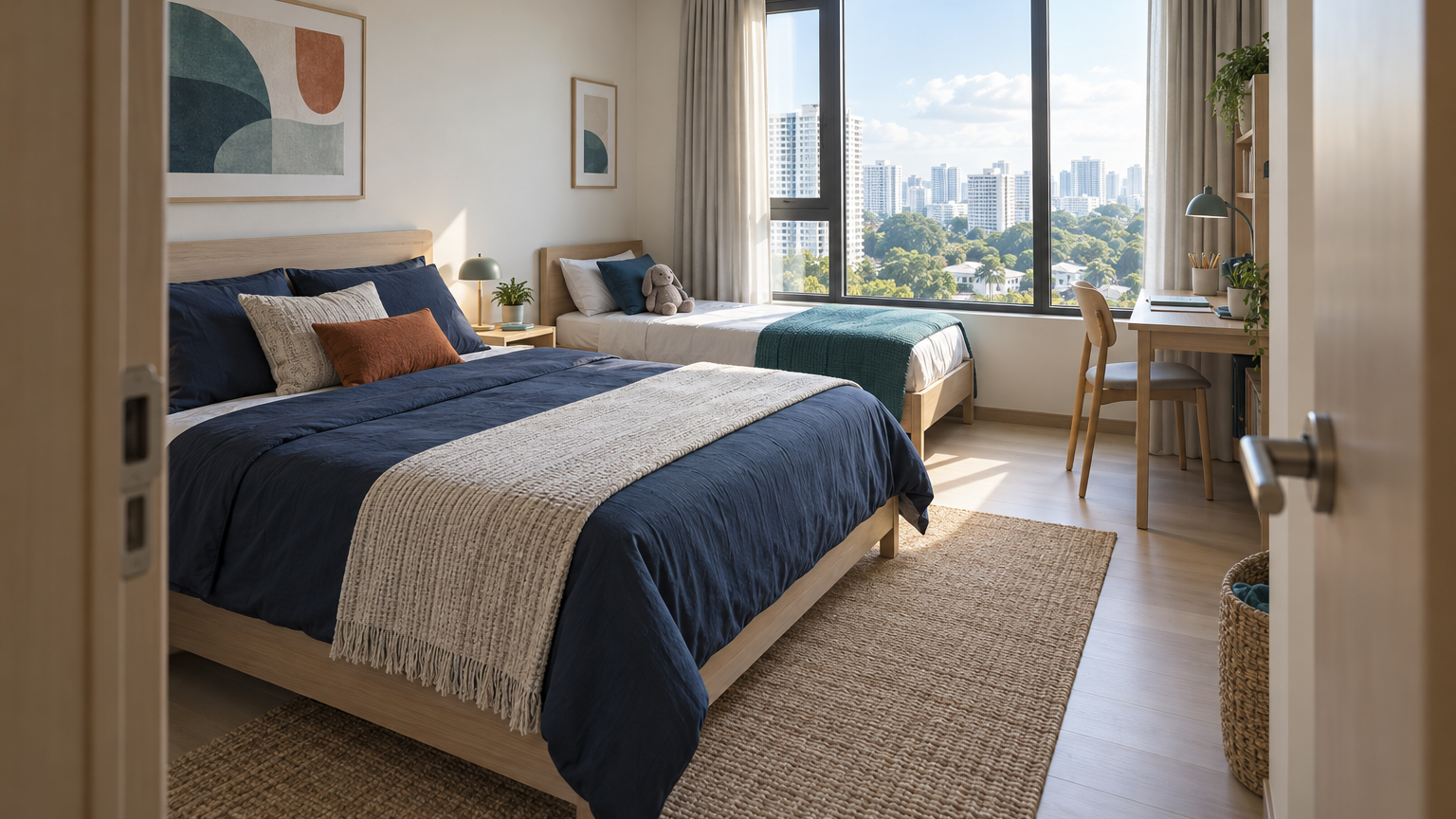
At Kerrisdale, the family selected an eighth-floor unit with living space that suited them. According to Chua’s account, each bedroom could accommodate a study table beside the bed. The main bedroom could fit a queen-sized bed for the parents and a single bed for their youngest child. These arrangements were non-negotiable for the couple.
That is a more useful description of suitability than the bedroom count alone. Their brief was not simply “three bedrooms”. It was a particular combination of sleeping and study spaces for five people.
There was still work to assess. Much of the unit was partitioned, but the owner had a video of its original layout that helped the couple picture the home after renovation. They also worked out that the renovation cost would fit their budget, taking the $30,000 loss into account.
For someone choosing a launch unit from a plan, this suggests a practical exercise: place the furniture your household actually needs before deciding that the room labels are enough. Start with the intended beds and desks, then consider access around them. Use the household expected at move-in, rather than only the arrangement that works today.
A size comparison with a clear boundary
The family also viewed units at Eight Riversuites. The account compared Kerrisdale three-bedroom units of about 1,260–1,280 sq ft with a similar unit type at Eight Riversuites of 980 sq ft. These are the report’s project-specific examples, not standard sizes for every three-bedroom home in either development.
Using those figures, the Kerrisdale examples offered about 280–300 sq ft more, or roughly 29%–31% more area than the 980 sq ft comparison. That calculation uses 980 sq ft as the denominator; it is not a comparison with the abandoned Ang Mo Kio launch unit.
The distinction is important. Eight Riversuites was part of the subsequent resale search, not the launch they walked away from. The figures help explain the alternatives the family considered, but do not measure exactly how much space they gained over their original booking.
For a launch buyer, the useful comparison is therefore two-stage: first compare overall area, then check whether the actual layout accommodates the required furniture and routines. More area and a workable arrangement are related questions, not interchangeable answers.
Put the household brief before the booking
In this case, the eventual purchase brought together the family’s room requirements and a renovation budget they considered manageable. They committed to forfeiting part of their new-launch option fee when they settled on the Kerrisdale home.
Before booking, a buyer can turn those same priorities into a short written brief: who sleeps in each room, where study or work happens, and when the household needs to move. A candidate unit should answer all three before its wider project appeal becomes decisive.
The family’s $30,000 loss was the cost of changing direction after booking. The clearest consequence of their choice was more immediate than a future resale outcome: they chose a home around how five people needed to live.