Canberra Drive EC Site Falls Under the S$18,000 Income Ceiling
The higher limit expands future eligibility, but there is no confirmed launch date, price or unit selection yet.
Published 2026-10-08 · 6 min read
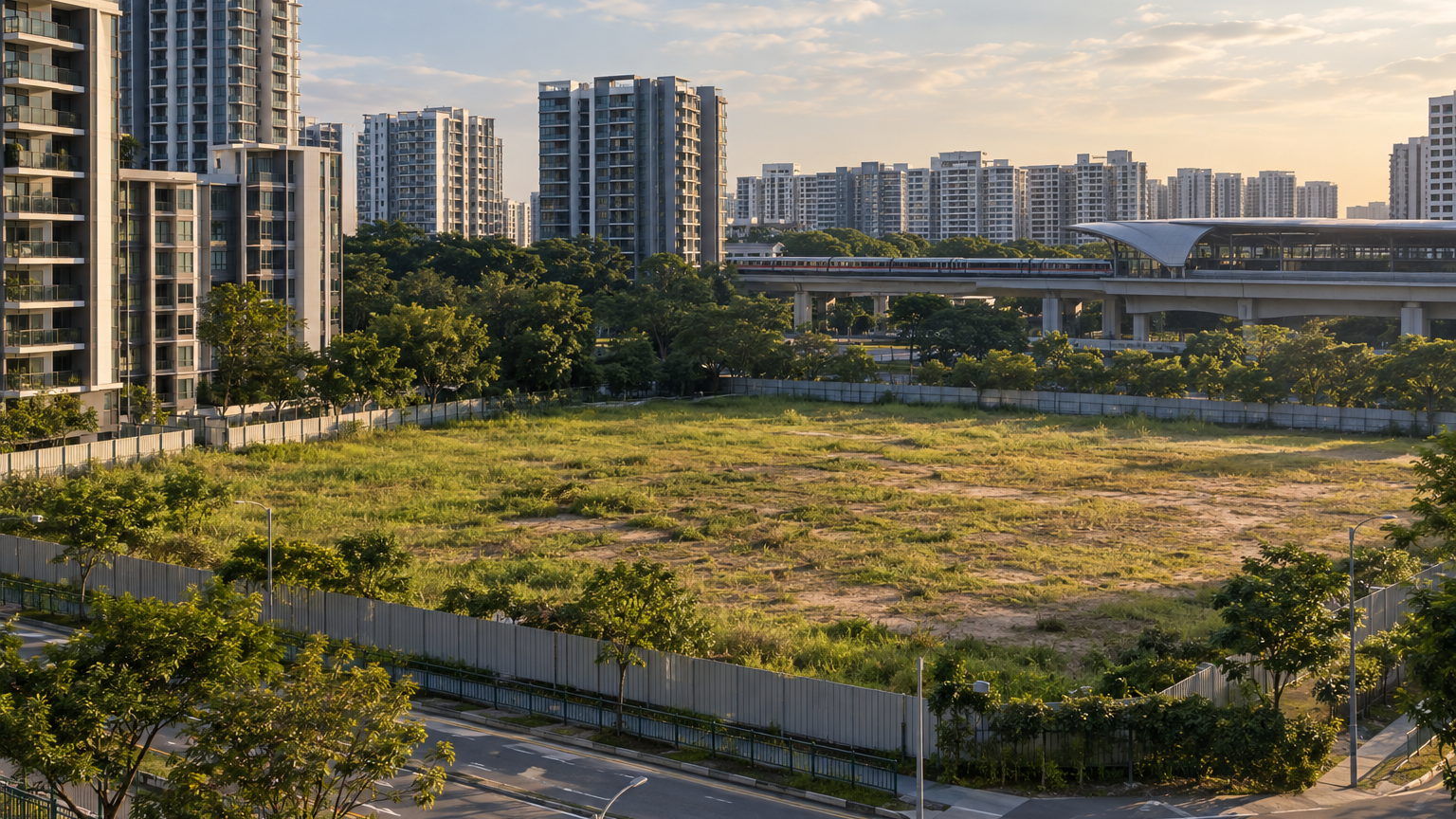
A household earning S$17,000 a month may pass the income test for a future executive condominium (EC) at Canberra Drive. It cannot, however, use the higher ceiling at every EC showflat: HDB ties the applicable ceiling to the land tender’s timing, not the day a buyer submits an application.
Canberra Drive’s tender deadline is listed as 1 October 2026, placing the site after the policy cut-off of 24 August 2026. That makes the planned EC relevant to households earning between S$16,001 and S$18,000—but there is no verified project name, launch date, price list or selection of units to book yet.
The tender date determines the income ceiling
HDB sets a monthly household-income ceiling of S$18,000 for new EC units built on sites whose tenders close on or after 24 August 2026. Sites awarded before that date remain subject to the earlier S$16,000 ceiling.
This distinction matters to households earning just above S$16,000. They may qualify for ECs arising from the later sites, provided they meet all the other eligibility conditions, but the higher ceiling does not retrospectively apply to every EC that happens to be marketed after the cut-off.
Canberra Drive is a straightforward example because HDB’s land-tender page records a submission deadline of 1 October 2026. The timing places the site on the S$18,000 side of the rule, but a land-tender deadline is not a launch date.
The official information currently establishes the site and its development parameters. It does not provide an eventual developer’s project name, approved unit mix, selling prices or sales timetable, so calling Canberra Drive a confirmed 2028 launch would go beyond the available evidence.
Canberra Drive is still a planned site, not sale inventory
The Canberra Drive parcel is intended for a 99-year leasehold EC development. It covers 11,535.4 sq m, allows up to 18,457 sq m of gross floor area—the total permitted floor space—and has a height limit of 40 metres.
HDB estimates that the site could yield 185 homes. That is a planning estimate rather than a final unit count: the official annex states that the eventual number proposed by the developer may vary.
URA’s first-half 2026 Government Land Sales programme provides some useful scale. It listed Canberra Drive at an estimated 185 homes and another EC site, then named Sembawang Drive, at an estimated 450 homes. These figures describe potential supply from land parcels, not approved projects or units ready for sale.
On those estimates, Canberra Drive is less than half the size of the other listed EC site. A smaller development could mean fewer units from which to choose, but the figures reveal nothing about bedroom types, stack orientation or floor-plan efficiency. Those details will require the eventual project’s approved plans and sales documents.
Buyers should apply the same discipline to proposed facilities. Pools, clubhouses, childcare facilities and landscaped grounds may be familiar features at ECs, but none should be treated as confirmed for Canberra Drive until official project materials identify them.
Passing the income test does not settle affordability
The income ceiling is only one eligibility gate. HDB also applies household-structure and citizenship requirements, while applicants who own private residential property—or disposed of one during the preceding 30 months—generally cannot apply.
An existing HDB flat owner must also dispose of their interest in that flat within six months after completing the EC purchase. Previous housing subsidies and the other conditions listed by HDB may affect an application as well.
Financing is a separate calculation. For a household earning exactly S$18,000, the 30% Mortgage Servicing Ratio (MSR) produces a monthly mortgage-instalment limit of S$5,400:
S$18,000 × 30% = S$5,400
The MSR applies to housing loans for direct purchases of EC units from developers. MAS also sets a 55% Total Debt Servicing Ratio (TDSR), which considers all monthly debt repayments rather than the housing loan alone.
The S$5,400 figure is not a guaranteed instalment or maximum loan offer. Actual borrowing capacity will depend on the lender’s assessment and factors including loan tenure, the borrowers’ ages and their other debts.
This leaves a household with three separate questions. Does it satisfy HDB’s eligibility rules? Can its cash and CPF funds cover the eventual upfront payments? And does the preferred unit fit within the mortgage limits after other debts are included? A higher ceiling answers only the first question.
Waiting for a new EC versus choosing a resale home
A household newly included by the S$18,000 ceiling faces a practical trade-off between waiting and certainty. Canberra Drive offers the prospect of a new EC on a qualifying site, but its final layouts, prices, launch timing and completion schedule are not established in the available site documents.
That uncertainty affects unit selection. The estimated 185-home capacity cannot show whether there will be a suitable three- or four-bedroom layout, how many stacks might face a road, or which homes could receive strong afternoon sun. Buyers cannot compare usable space or views until proper floor plans and a site plan become available.
A completed resale home offers a different kind of evidence. Buyers can visit the actual unit, listen for road or neighbour noise and inspect its condition. Someone facing a firm tenancy expiry, school deadline or family move may reasonably value that certainty more than the possibility of securing a future new EC.
Waiting may suit a household with more flexibility, particularly one newly brought within the EC income limit. But the waiting period should be treated as open-ended until an official sales timeline and completion date are published—not reverse-engineered from an assumed launch year.
What the higher ceiling changes today
Canberra Drive’s stated tender deadline places its eventual new EC units within the S$18,000 household-income ceiling. This widens the potential applicant pool beyond households that fitted under the previous S$16,000 limit.
What it does not provide is a home to select. The official site estimate of 185 units is not a price list, confirmed unit mix or booking opportunity, and the eventual developer’s proposal may contain a different number of homes.
For the S$17,000 household, the policy change creates a future option rather than access to today’s showflats. The ceiling can answer “might we qualify?” Only the eventual launch documents can answer the more useful questions: which unit, at what price and after how long a wait?